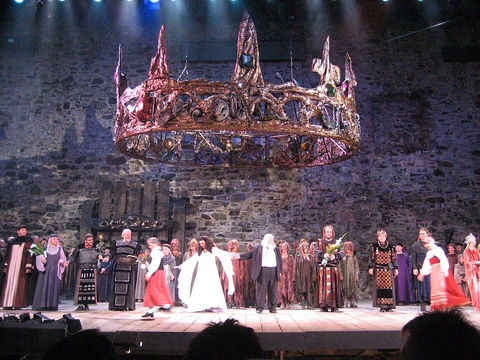
Farinelli
Italian castrato soprano, among the greatest in opera history.

He is regarded as one of the greatest singers in the history of opera, renowned for his soprano voice and extraordinary technical skill.
- known_for
- Celebrated castrato soprano with a range from C3 to D6
Lore & Background
Farinelli was born in Andria into a musical family; his father Salvatore Broschi was a composer and maestro di cappella. He studied under Nicola Porpora and made his debut at age fifteen in the serenata Angelica e Medoro, with text by Metastasio, who became a lifelong friend. Farinelli quickly gained fame across Italy as 'il ragazzo'. He performed in Parma, Milan, Bologna, and Venice, often alongside other leading singers. His first documented performance in Vienna was in 1730, when he sang in Johann Joseph Fux's 'Costanza e Fortezza'.
Reader's Guide
Farinelli's significance lies in his exceptional vocal abilities and his influence on 18th-century opera. Contemporary accounts, such as that of Johann Joachim Quantz, describe his voice as penetrating, full, rich, and bright, with extraordinary breath control and agility. He was known for his fertile invention of free ornamentation in adagio. His legacy endures as a benchmark of castrato singing, though many details of his life remain uncertain or based on anecdote.
Did You Know?
- Farinelli's stage name may derive from two Neapolitan lawyers, the brothers Farina, who possibly sponsored his studies.
- He and the poet Metastasio referred to each other as 'caro gemello' ('dear twin'), though they did not make their debuts on the same day.
- His low range extended to C3, as heard in an aria he wrote himself for the pasticcio Artaserse.
Early Life & Musical Formation
His father, Salvatore Broschi, held the post of composer and maestro di cappella at the Andria Cathedral, while his mother Caterina Barrese hailed from Naples. The family's standing in the local musical community was such that the Duke of Andria, Fabrizio Carafa of the prestigious Neapolitan Carafa dynasty, took a leading part in the boy's baptism. After a period in Barletta, the family relocated to Naples at the end of 1711, where young Carlo was introduced to Nicola Porpora, the most renowned singing teacher in the city and a successful opera composer in his own right. Under Porpora's guidance, the boy's vocal abilities developed with remarkable speed, and by fifteen he was ready for the stage.
Vocal Mastery & the Bernacchi Encounter
Contemporary accounts paint a vivid picture of Farinelli's instrument. Quantz singled out the singer's pure intonation, extraordinary breath control, and the effortless agility with which he navigated the widest intervals. Passagework, melismas, and the invention of free ornamentation in slow movements all came to him naturally. His full documented range, as confirmed by surviving arias and cadenzas, spanned from F3 to D6. Yet even a singer of such command was humbled. Farinelli displayed every facet of his beauty and virtuosity, only for Bernacchi to mirror each trill and roulade with even greater refinement and add variations of his own. Farinelli conceded defeat and asked Bernacchi to teach him what he called ultra-refined graces.
A Career That Spanned the Continent
Farinelli's reputation as il ragazzo spread rapidly through Italy before he was even twenty, and his career quickly carried him across the European stage. A near-legendary anecdote from this period tells of an aria with trumpet obbligato in which the singer and trumpeter engaged in a contest of technique and ornamentation; according to the music historian Charles Burney, Farinelli ultimately silenced the trumpet player through sheer acclamation of the audience, though no surviving work in his known repertoire contains such an aria. Each appearance was met with what contemporaries described as tumultuous applause, cementing his status as the most sought-after voice of his generation.
The Metastasio Bond & Enduring Legacy
Perhaps no relationship shaped Farinelli's artistic identity as profoundly as his bond with Pietro Trapassi, better known as Metastasio. The two made their respective debuts on the same day in 1720, when Farinelli sang in Porpora's serenata Angelica e Medoro, whose text was Metastasio's first. Each man frequently called the other his caro gemello—dear twin—and the friendship endured for the rest of their lives, intertwining the careers of opera's most celebrated singer and its most celebrated librettist. Farinelli's place in musical history rests on the convergence of extraordinary natural gifts and rigorous training. His soprano range, confirmed by arias requiring sustained C6 notes and his own cadenzas reaching down to F3, combined with the technical ease praised by Quantz and the stylistic refinement he acquired from Bernacchi, made him a benchmark against which later singers were measured. Regarded as one of the greatest voices in the entire history of opera, Farinelli lived to the age of seventy-seven, dying on 16 September 1782, leaving behind a legacy that outlasted the castrato tradition itself.
Frequently Asked Questions
What was Farinelli's vocal range?
His soprano voice spanned from C3 up to D6, giving him a range of over three octaves. That blend of deep resonance and brilliant upper register was remarkable even among the elite castrati of his era.
Why is Farinelli considered one of the greatest opera singers?
He paired a naturally gorgeous soprano timbre with a level of technical mastery that audiences across Europe found almost supernatural. His reputation as a singing virtuoso has endured for well over two centuries.
What was Farinelli's real name?
His full birth name was Carlo Maria Michelangelo Nicola Broschi. He performed under the family nickname Farinelli, a diminutive form tied to his family's background in the flour and pasta trade.
Did Farinelli do anything besides performing?
Yes—he was also active as a composer and musician beyond his concert and opera appearances. His contributions to music extended well past the stage, shaping the broader musical culture of 18th-century Europe.
More in Opera Singers 1-24
Elsewhere in the Opera Singers universe
Spotted an error? Know more?
This is a living reference — every entry is fact-audited, and reader corrections feed straight into our audit queue. Suggest an edit · See this site's audit record