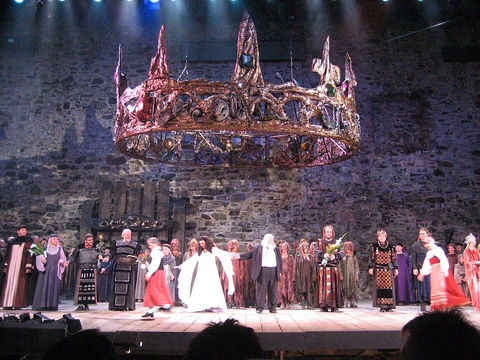
Anna Netrebko
Russian soprano known for lyric, coloratura, and heavier romantic roles.

Anna Yuryevna Netrebko (born 18 September 1971) is a Russian operatic soprano who has performed at the Salzburg Festival, Metropolitan Opera, Vienna State Opera, the Royal Opera and La Scala. Discovered and promoted by Valery Gergiev, she began her career at the Mariinsky Theatre, collaborating with the conductor in the theater and performances elsewhere. She was noticed globally after playing Donna Anna in Mozart's Don Giovanni at the 2002 Salzburg Festival. She had been known for her rendition of lyric and coloratura soprano roles, yet later proceeded into heavier 19th-century romantic roles, such as Leonora in Il trovatore and the role of Lady Macbeth in Macbeth. Since 2016, she has turned her focus to verismo repertoire.
- known_for
- Performances at Salzburg Festival, Metropolitan Opera, Vienna State Opera; Peopl
Verified Timeline
Lore & Background
Netrebko was born in Krasnodar in a family of Kuban Cossack background. While studying at the Saint Petersburg Conservatory, Netrebko worked as a janitor at Saint Petersburg's Mariinsky Theatre. Later when she auditioned for the theatre, conductor Valery Gergiev, recognizing her from her prior work, subsequently became her vocal mentor. Under Gergiev's guidance, in 1994 Netrebko made her operatic stage debut at the Mariinsky at age 22 as Susanna in The Marriage of Figaro despite initially being billed as Barbarina. In the same year, she also performed as the Queen of the Night in Mozart's The Magic Flute with the Riga Independent Opera Avangarda Akadēmija under conductor David Milnes. In autumn 1995, Netrebko made her American debut with Lyudmila at the San Francisco Opera. Following this successful performance, she was enrolled in the Merola Opera Program in summer 1996 and became a frequent guest singer in San Francisco in the next seasons.
Reader's Guide
Netrebko's significance lies in her transition from lyric and coloratura soprano roles to heavier 19th-century romantic roles, such as Leonora in Il trovatore and Lady Macbeth in Macbeth, and later to verismo repertoire from 2016. Her international breakthrough came in August 2002, when she sang Donna Anna in Don Giovanni conducted by Nikolaus Harnoncourt at the Salzburg Festival, where she would be particularly associated. She has been an exclusive artist for Deutsche Grammophon since 2003. She has won multiple Echo Klassik Awards, and was included on the Time 100 list in 2007. She was named a People's Artist of Russia in 2008, and an Austrian Kammersängerin in 2017. Her career demonstrates sustained versatility across major opera houses and festivals, with a notable expansion into heavier Verdi roles and verismo works.
Did You Know?
- While studying at the Saint Petersburg Conservatory, Netrebko worked as a janitor at the Mariinsky Theatre before being discovered by conductor Valery Gergiev.
- She made her operatic stage debut at age 22 as Susanna in The Marriage of Figaro, despite initially being billed as Barbarina.
- Her international breakthrough came in August 2002 when she sang Donna Anna in Don Giovanni at the Salzburg Festival.
- She has been an exclusive artist for Deutsche Grammophon since 2003.
- She presented the Deutscher Medienpreis 2009 to Chancellor Angela Merkel on 9 February 2010.
From Krasnodar to the Mariinsky Stage
Anna Yuryevna Netrebko entered the world on 18 September 1971 in Krasnodar, a city in southern Russia, into a family rooted in the Kuban Cossack tradition. Her path toward the operatic stage was anything but straightforward. While a student at the Saint Petersburg Conservatory, she took a job cleaning the floors of the very Mariinsky Theatre where she would one day take the lead. It was there, in the unglamorous hours of janitorial work, that she first crossed paths with the world of professional opera. When she eventually auditioned for the company, conductor Valery Gergiev — who had already noticed her from her earlier presence in the building — stepped in as her vocal mentor. Under his guidance, she made her stage debut in 1994 at the age of twenty-two, singing Susanna in Mozart's The Marriage of Figaro, though she had originally been billed for the smaller role of Barbarina. That same year she tackled the demanding Queen of the Night in The Magic Flute with the Riga Independent Opera Avangarda Akadēmija under conductor David Milnes, signaling early on that her ambitions stretched well beyond the lyric soprano category.
The Salzburg Breakthrough and Global Ascent
The summer of 2002 changed everything. After debuting with the Metropolitan Opera in February of that year as Natasha in the company's premiere of Prokofiev's War and Peace, Netrebko stepped onto the Salzburg Festival stage in August to sing Donna Anna in Mozart's Don Giovanni under Nikolaus Harnoncourt's baton. That performance announced her to the international opera world and cemented her association with the festival. Within months she was at the Royal Opera House singing Servilia in La clemenza di Tito, and by 2003 she had made her debuts at both the Vienna State Opera and the Bavarian State Opera as Violetta in La traviata. Her Los Angeles Opera debut followed in November 2003 with Lucia di Lammermoor. The trajectory accelerated: a Carnegie Hall recital debut in May 2007 alongside Dmitri Hvorostovsky, an appearance at the Last Night of the Proms on 8 September 2007, and an invitation to honor Martin Scorsese at the Kennedy Center Honors in December of that year. By the late 2000s she had become a fixture at the world's leading houses, returning season after season to San Francisco, the Met, Covent Garden, and beyond.
A Voice That Kept Growing
Netrebko built her early reputation on the lyric and coloratura soprano repertoire, delivering memorable accounts of Susanna, the Queen of the Night, Musetta, Zerlina, Nannetta, Adina, and Ilia across her formative years. Yet she never stayed within that comfortable lane. As her career matured, she deliberately pushed into the heavier, more dramatically demanding territory of nineteenth-century romantic opera, taking on Verdi's Leonora in Il trovatore and the formidable Lady Macbeth in Macbeth. This willingness to expand her dramatic palette became a hallmark of her artistic identity. Then, beginning in 2016, she shifted her focus yet again, turning her considerable gifts toward the verismo repertoire — a world of raw emotional intensity and vocal power that few sopranos of her generation have explored with such commitment. Her journey from the sparkling coloratura of La sonnambula's Amina to the tragic weight of Leonora and beyond illustrates a singer who treated each new period of repertoire as a fresh challenge rather than a comfort zone.
Honors, Recordings, and Life Beyond the Stage
Beyond the opera house, Netrebko's career has been marked by a steady accumulation of prestigious recognition. She has been the exclusive recording artist for Deutsche Grammophon since 2003, and her work has earned her multiple Echo Klassik Awards. In 2007 she was named to the Time 100 list of the world's most influential people, and the following year the Russian government honored her with the title of People's Artist of Russia. Austria recognized her in 2017 by bestowing the title of Kammersängerin. Her public appearances have extended well beyond the stage: she presented the Deutscher Medienpreis 2009 to Chancellor Angela Merkel on 9 February 2010, performed at the Vienna Opera Ball, and sang at the Last Night of the Proms. Her career has not been without personal challenges — she withdrew from engagements in 2004 citing exhaustion, cancelled performances in 2008 due to a bronchial condition, and took maternity leave before returning to the Mariinsky in January 2009 to sing Lucia. These moments of vulnerability have only deepened the admiration of audiences who see in her a singer who balances extraordinary ambition with very human limits.
Frequently Asked Questions
Who is Anna Netrebko?
Anna Netrebko is a Russian soprano born in 1971 who has become one of the most recognizable voices in contemporary opera. She is celebrated for moving fluidly between lyric, coloratura, and heavier romantic repertoire.
What roles is Anna Netrebko known for?
She is particularly associated with lyric and coloratura arias as well as more demanding romantic soprano parts. Her breakthrough role was Donna Anna in Mozart's Don Giovanni at the 2002 Salzburg Festival.
How did Anna Netrebko begin her career?
She was first identified and championed by conductor Valery Gergiev, who helped launch her professional path at the Mariinsky Theatre in St. Petersburg. From there she quickly moved onto the international stage.
What major honors has Anna Netrebko received?
In 2008 she was granted the title of People's Artist of Russia, and in 2017 Austria recognized her with the Kammersängerin distinction. These awards reflect her standing in both her home country and the broader European opera world.
Where has Anna Netrebko performed?
She has appeared at some of the most prestigious opera houses in the world, including the Metropolitan Opera, Vienna State Opera, La Scala, and the Royal Opera House. The Salzburg Festival remains one of her most frequently associated stages.
More in Opera Singers 25-33
Elsewhere in the Opera Singers universe
Spotted an error? Know more?
This is a living reference — every entry is fact-audited, and reader corrections feed straight into our audit queue. Suggest an edit · See this site's audit record